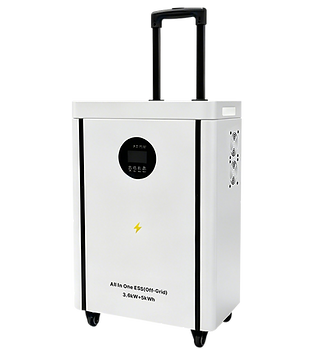
Solreach All In One ESS(6.5KW+16KWH)


Solreach All In One ESS(6.5KW+16KWH)
-
BATTERY CELLS
-
INVERTER
-
WARRANTY
-
Operating Protection
-
Operating Temperature
A-grade Gotion cells
CTVE (Shiyuan)
5 Years
IP54
-10°C~60°C
Description
The Solreach All-in-One ESS 6.5KW 16KWh is the highest-capacity model in the Solreach lineup, built for energy-intensive residential, commercial, and off-grid installations where one or two days of full autonomy is required. Operating on a true 51.2VDC (nominal) architecture — the only 48V-class unit in the Solreach range — it delivers 6KW rated continuous AC output, a 12KVA surge ceiling, and 94% peak inverter efficiency. The 16KWh LiFePO₄ battery provides 14.4KWh of usable energy at 90% DoD.
Advantages
16KWh capacity — full-day autonomy for heavy users
-
14.4KWh usable at 90% DoD — the highest in the Solreach ESS range, double the 5KW model
-
Supports 2–3 days of autonomy for a typical household on 2–3KWh/day consumption
-
150A / 150A symmetric charge-discharge current enables fast cycle turnaround for commercial deployments
51.2V true 48V architecture — higher efficiency, lower cable loss
-
51.2VDC nominal (40–58.4VDC range) — operates at 2× the voltage of the 25.6V models, halving DC cable current and reducing resistive loss
-
Peak inverter efficiency reaches 94%@48VDC — 1% higher than the 5KW model's 93%@25.6V
-
Industry-standard 48V bus makes it natively compatible with third-party BMS, EV chargers, and DC-coupled solar arrays
12KVA surge — powers the full commercial load spectrum
-
12KVA surge (2× rated output) — 20% higher than the 5KW model's 10KVA, enabling simultaneous start of multiple motor loads
-
Overload tolerance: 1 min @ 102–120% load; 10 s @ 120–200% load — matches the demands of clinic and cold-chain logistics equipment
-
Pure sine wave output at 208/220/230/240VAC ensures compatibility with sensitive medical, refrigeration, and telecom equipment
Specifications Parameter
Output Voltage Waveform
Rated AC Output Power
Rated AC Output Power
Rated AC Output Power
Rated AC Output Power
Output Voltage
Output Voltage
Output Voltage
Output Voltage
Low DC Warning Point
Low DC Warning Point
Low DC Warning Point
Low DC Warning Point
Low DC Warning Point
Low DC Warning Point
Low DC Cut -off Voltage
Surge Power (kVA)
Surge Power (kVA)
Voltage (VAC)
Voltage (VAC)
Voltage (VAC)
Power Factor (PF)
Power Factor (PF)
Rated Capacity (kW)
AC Input
Rated Input Voltage (VAC)
208/220/230/240; L+ N +PE
Voltage Range (VAC)
90~280+3 (normal mode); 170~280+3 (UPS mode)
Frequency (Hz)
50 / 60 (Auto Adaptive)
AC Output
Rated Capacity (kW)
6
Surge Power (kVA)
12
Voltage (VAC)
208/220/230/240
Power Factor (PF)
1
Frequency (Hz)
50/60Hz+0.1%
Switch Time (ms)
10
Wave Form
Pure Sine Wave
Overload Capacity (Battery Mode)
1min@102%-120%load, 10s@120%-200% load
Charger (PV+AC)
Solar Charger Type
MPPT
Max PV Input current /power
27A/9000W
Operating Voltage Range (VDC)
80-450
Max PV Open Circuit Voltage (VDC)
500
Max PV Charge Voltage (A)
120
Max AC Charge Current (A)
120
Max. Charge Current (PV + AC)(A)
120
Battery
Nominal Battery Voltage
51.2VDC
Rated Energy
16KWh (0.5C,25°C)
Usable Enerqy (90% DOD)
14.4kwh
Max. Charge/Discharge Current
150A/150A
Operation Voltage Range
40vdc~58.4Vdc
Operation Temperature
-10°C~+60°C
Intertace
revea
LCD
communication
USB
Monitoring
WIFI
General Protection
Operating Protection
IP54
Operating Temperature
-10°C~60°C
Relative Humidity
5% ~ 95% (Non-condensing)
Storage Temperature
-15°C~60°C
Max Operating Altitude
4000m (Derating above 1000m)
Dimension
LxWxH (products size, mm)
550*246*1180mm
LxWxH (package size, mm)
630*420*1264mm
Weight(NW Kg)
168Kg
Weight(GW Kg)
192Kg

FAQs
Q1: Why does the 6.5KW 16KWh ESS use a 51.2VDC architecture instead of the 25.6V used in smaller models?
The 51.2VDC (nominal 48V-class) architecture is standard for systems above 5KW because it halves the DC bus current relative to a 25.6V system delivering the same power — reducing cable sizing requirements, connector heat, and resistive losses across longer DC runs. For installers managing commercial-scale deployments where battery and inverter may be separated by several meters, the 48V bus significantly reduces BOS costs and improves long-term reliability.
Q2: How much actual usable energy does the 16KWh battery provide, and how long will it run a typical load?
At 90% depth of discharge, usable energy is 14.4KWh. Practical runtimes: a 500W refrigerator + lighting load (~800W total) runs approximately 18 hours; a 2KW air conditioner runs approximately 7.2 hours; a 6KW full-rated load runs approximately 2.4 hours. For commercial applications such as telecom base stations (typically 1–2KW continuous), a single unit can provide 7–14 hours of uninterrupted backup from a full charge.
Q3: What is the operating voltage range of the 51.2V battery and how does the BMS manage cell health?
The battery operates between 40.0VDC and 58.4VDC, corresponding to cell-level voltages of approximately 3.0V to 3.65V per cell in a 16S LiFePO₄ configuration. The BMS applies active cell balancing to equalize charge distribution across all cells during both charge and discharge, preventing capacity divergence over time. Maximum charge and discharge current is symmetrically rated at 150A / 150A — the only symmetric rating in the Solreach ESS range, simplifying system sizing for bidirectional energy applications.
Q4: Can the 6.5KW 16KWh ESS serve as a primary power source for a small commercial building or clinic?
Yes. The combination of 6KW continuous output, 12KVA surge, 14.4KWh usable battery, and 9000W MPPT solar charging makes this unit sufficient as the sole power source for a small clinic (1–3 consultation rooms), a rural school (lighting, computers, fans), a small cold-storage facility (one 3-ton compressor unit), or a telecom tower with microwave and battery backup. For buildings with peak demand above 6KW, Solreach's technical team can advise on dual-unit configurations.
Q5: How does the 94% peak efficiency figure translate into real-world energy savings for OEM buyers?
At 94% inverter efficiency versus an industry average of 90–92% for competing all-in-one units at this power class, the Solreach 6.5KW ESS wastes approximately 2–4% less energy on every cycle. For a system cycling 14.4KWh daily, this saves roughly 0.3–0.6KWh per day — or 110–220KWh per year — per unit. At scale across a fleet of 50 OEM-deployed units, this translates to 5,500–11,000KWh of recovered energy annually, reducing grid top-up costs and improving the ESS's payback period for end customers.
Q6: What makes the 6.5KW 16KWh model the preferred choice for highland and remote off-grid markets?
Three specifications make this unit uniquely suited for highland deployments: (1) maximum operating altitude of 4000m with managed derating above 1000m — verified for markets like Ethiopia, Rwanda, Bolivia, and Nepal; (2) operating temperature range of −10°C to +60°C covering the extreme thermal swings of highland environments; (3) 9000W MPPT input means that even at altitude where irradiance is lower and panels underperform, the system can still fully recharge the 16KWh battery from a reasonably sized PV array within a single solar day.
Q7: What are the physical dimensions, shipping weight, and logistics considerations for container import?
Product dimensions: 550 × 245 × 1180mm (L×W×H). Packaged dimensions: 630 × 420 × 1264mm. Net weight: 168kg. Gross weight: 192kg. At 192kg gross per unit, a standard 20-foot container (max payload ~21,500kg) can accommodate approximately 112 units. A 40-foot HQ container can carry approximately 230 units. Units ship as lithium battery equipment under UN 38.3 / Class 9 dangerous goods regulations and require MSDS and UN transport documentation, which Solreach provides as standard with all export orders.